Data guide · training corpus
BONES-SEED: where the 350,000 clips live
Every MotionBricks explainer quotes “over 350,000 motion clips” and then stops. This post follows the paper trail instead: which page the README points to, what the dataset itself says it contains, and how the released training scripts behave with and without it.
Three pages, three different roles
- The README's pointer. The MotionBricks README names bones.studio/datasets as the place to download the motion datasets — twice, in the Training section and again under Dataset. Related Work describes the corpus as “350k production-grade mocap clips from real human actors and actresses.”
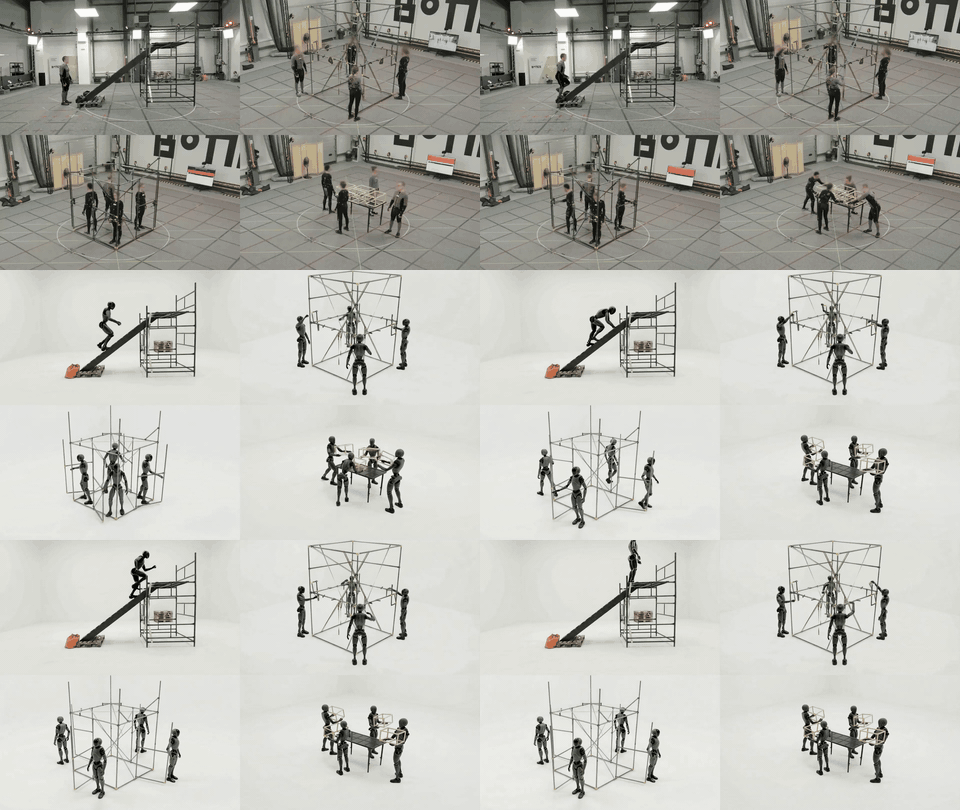
- The dataset page. The BONES-SEED card on Hugging Face is where the corpus details live: the official page counts 142,220 clips and roughly 288 hours — the G1-retargeted trajectories inside the larger mocap collection. Read the card for exactly what each subset contains.
- This site's fact sheet. The home page links the 350,000 figure back to the sentence on the project page it came from, and the correction post untangles which number refers to what.
How it feeds training — and what happens if you skip it
One more pipeline step before the data is MotionBricks-shaped: the SOMA Retargeter is the Newton-based solver that converts SOMA capture onto the G1's skeleton, producing the robot-ready trajectories.
Then, from the README verbatim in spirit: the shipped training scripts (train_vqvae.py, train_pose.py, train_root.py) default to synthetic data, on purpose — so you can verify the whole pipeline end-to-end without downloading the real corpus. The real dataset is what you need to reproduce the pretrained checkpoints, not to make the code run.
Practical order, after the setup guide: (1) run synthetic training to prove the environment works; (2) pull BONES-SEED from the pages above once you actually care about reproduced weights; (3) check licensing on the dataset's own page before any commercial plan — this unofficial guide will not paraphrase terms you can read there in one minute.
Why the corpus matters to the architecture story
The scalability claim — one latent backbone covering 350,000-plus clips instead of a model zoo — is only interesting because the data is broad: walking, crawling, injured gaits, object contact. The GIF gallery in the README (see a few on the styles page) is effectively a sampling of that breadth. When someone asks “is 350,000 a big number for motion capture,” the more useful answer is what it is big relative to: prior single-model motion work trained on substantially smaller corpora, which the paper discusses in its related-work sections.