The robot side of the stack · facts from the GR00T-WBC model card
SONIC: where MotionBricks motion meets a real G1
MotionBricks answers "what should this character do next?". GEAR-SONIC answers "make a 30 kg robot actually do it". Both ship inside the same repository, and the README is explicit that they anchor NVIDIA's GR00T Whole-Body Control plan together.
How the two projects relate
The README's Related Work section states it in one sentence: "Together with MotionBricks, GEAR-SONIC anchors NVIDIA's GR00T Whole-Body Control initiative." In practice that means one shared monorepo (NVlabs/GR00T-WholeBodyControl), MotionBricks as the motion-generation layer (how the latent models work), and SONIC as the tracking controller that turns reference motion into motor behaviour on the Unitree G1.
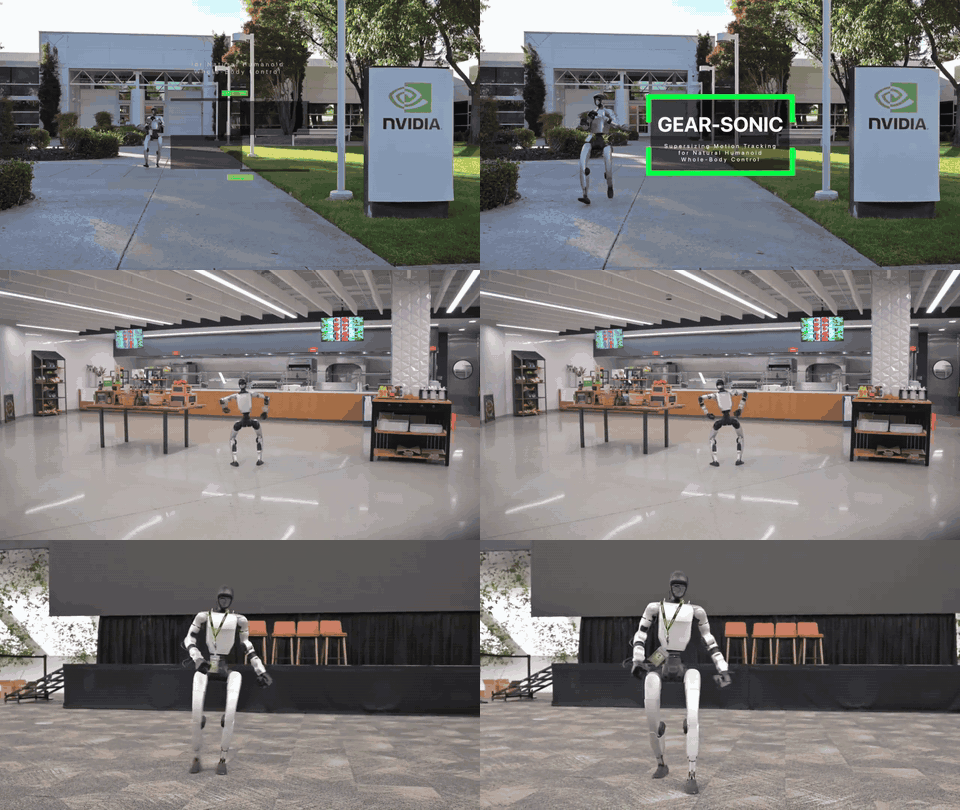
Official SONIC sources: project page · nvidia/GEAR-SONIC on Hugging Face · parent repo.
The three checkpoints
Verbatim from the GR00T-WBC model card — every checkpoint is in the nvidia/GEAR-SONIC Hugging Face repo:
| Checkpoint | Reference lookahead | Intended use | Download |
|---|---|---|---|
| Default SONIC (original release) | 10 future frames at 20 ms spacing, approximately 200 ms of reference lookahead | Default general-purpose SONIC controller for motion tracking, planning, teleoperation, and compatibility with existing deployments. G1 and teleoperation future-reference observations use step5. | nvidia/GEAR-SONIC · main |
| Low-latency teleoperation | 4 future frames at 20 ms spacing, approximately 80 ms of reference lookahead | Intended for more responsive whole-body teleoperation and VLA execution. G1 and teleoperation future-reference observations use step1. Use its encoder, decoder, and observation config together. | nvidia/GEAR-SONIC · low_latency |
| SONIC v1.1 | 10 future frames at 20 ms spacing, approximately 200 ms of reference lookahead | Uses robot-heading-normalized target orientation and was trained with wrist-pose augmentation. Intended for heading-stable whole-body teleoperation and SONIC-backed VLA policies that use this controller. G1 and teleoperation future-reference observations use step5; this is not the low-latency model. | nvidia/GEAR-SONIC · sonic_v1_1 |
SONIC in the release timeline
The parent repo's news feed, SONIC-relevant entries only (full feed on the news page):
- 2026-05-07 — GR00T-WBC: end-to-end VLA workflow on G1 (teleop data → Isaac-GR00T N1.7 fine-tune → SONIC deployment).
- 2026-06-16 — GR00T-WBC: low-latency teleoperation checkpoint (4-frame lookahead) + Isaac Teleop Setup docs.
- 2026-07-23 — GR00T-WBC: SONIC v1.1 checkpoint (robot-heading-normalized, wrist-pose augmentation).
MotionBricks' own 2026-04-27 preview release is the starting point of the combined story; the checkpoint rows above are what arrived on the SONIC side afterwards.
Where to read next
MotionBricks vs NVIDIA's stack
How the pieces of GR00T (and what is NOT part of it) sort out.
Architecture
The VQVAE / pose / root models on the generation side of the pair.
News timeline
Every dated entry from both READMEs, with sources.