Overview · NVIDIA's motion-generation layer
NVIDIA MotionBricks: the whole picture in one page
MotionBricks — written as two words in many searches, and occasionally misspelled "nvidia motionbrix" — is NVIDIA's real-time generative motion framework, presented at SIGGRAPH 2026 / ACM Transactions on Graphics. This page gathers what NVIDIA has actually released, where it lives, and what you may do with it.
Many community posts repeat a “5,000 FPS” figure. It is wrong: the official project page and README both state 15,000 FPS / 15000 FPS. Cite the paper, not the hype thread.
What NVIDIA built
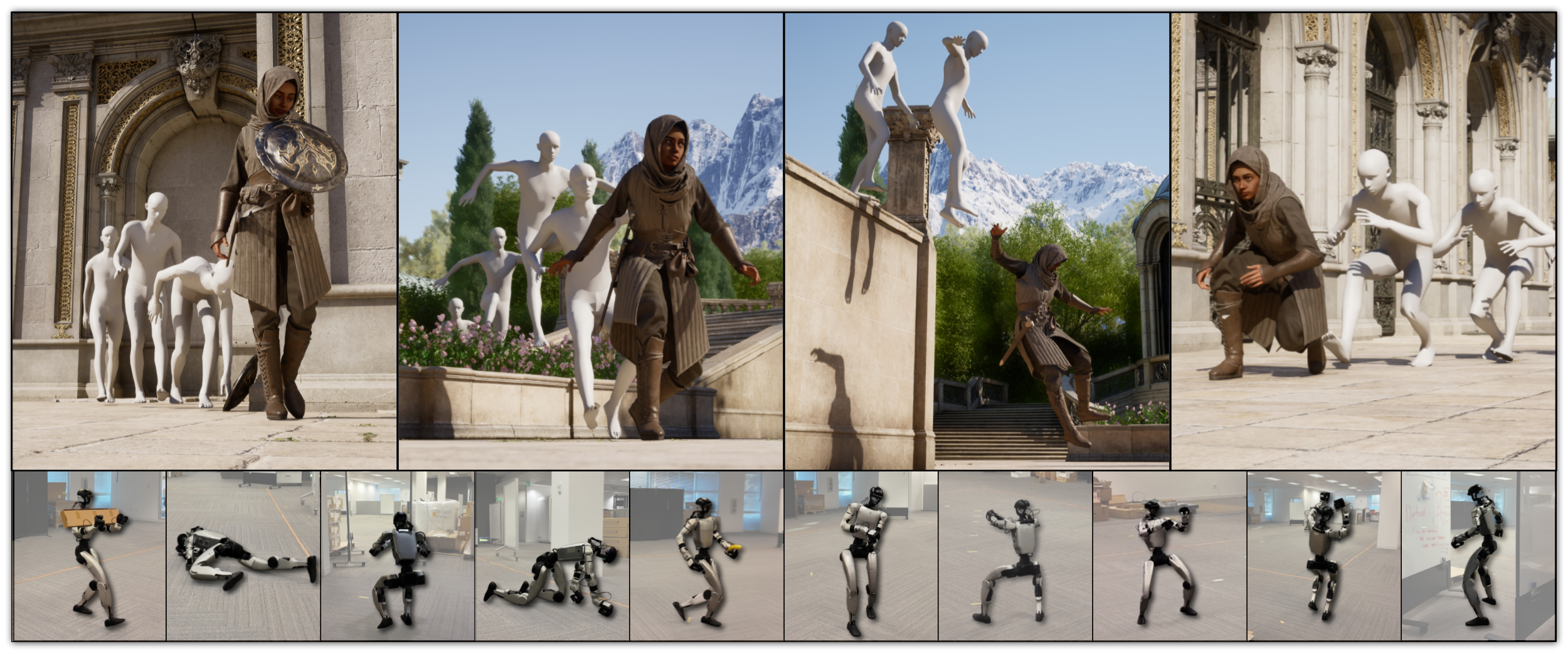
In one sentence from the paper's own framing: a large-scale modular latent generative model — trained on 350,000+ motion clips and running at 15,000 FPS with 2 ms latency — paired with "smart primitives" that expose it as simple commands: velocity, heading and style for locomotion; proxy keyframes for object interaction. New tasks are handled zero-shot, and the flagship UE5 demo states its recipe as no foot-locking, no blending, no collision detection, no hand-authored transitions. The full breakdown is on the architecture page.
Where it sits: a core organic component of GR00T WBC
MotionBricks does not stand alone at NVIDIA. The official project page says it directly — quoting the words used there: MotionBricks "is now a core organic component of NVIDIA's GR00T Whole-Body Control effort, powering the motion-generation layer of the stack." Next to it sits GEAR-SONIC (whole-body robot control) and sibling offline generator Kimodo. How the layers differ — and which SONIC checkpoint's lookahead (200 ms / 80 ms / 200 ms) fits your teleop budget — is mapped on the GR00T-SONIC page.
How to get it
The code lives inside the GR00T-WholeBodyControl monorepo under the NVlabs GitHub organization — this is the answer to "where is the nvidia motionbricks github". The clone path from the README, verbatim:
git clone https://github.com/NVlabs/GR00T-WholeBodyControl.git
cd GR00T-WholeBodyControl/motionbricks
Checkpoints (~2.2 GB, four files) are LFS-tracked and skipped by default; the setup guide has the exact git lfs pull commands and the 1 KB pointer-file check that catches the usual install failure. Requirements per the README: Python 3.10+, a CUDA-capable GPU, Git LFS.
License summary
| What | License |
|---|---|
| Source code | Apache License 2.0 |
| Pretrained weights | NVIDIA Open Model License — permits commercial use with attribution, subject to the trustworthy AI requirements. |
This is a summary of the README's license section, not the legal text — read the license files in the official repository before commercial use.
Official NVIDIA channels — the complete list
- Project page: nvlabs.github.io/motionbricks
- Code (monorepo): github.com/NVlabs/GR00T-WholeBodyControl · motionbricks/ subdirectory
- Paper PDF: SIGGRAPH 2026 paper · arXiv:2604.24833 · DOI 10.1145/3811334
- 4K demo download: the uncut UE5 runtime demo (1.2 GB)
- Training datasets: bones.studio/datasets · BONES-SEED on Hugging Face
- Motion representation docs: docs/motion_representation.md · custom data: docs/adding_your_own_dataset.md
- NVIDIA contact for the project: gear-wbc@nvidia.com
Pick your path from here
Install it
LFS-aware clone, checkpoints, dependencies — 20 minutes to a running demo.
UE5 integration
What NVIDIA shipped for Unreal and what is video-and-paper only.
GR00T & SONIC
The robotics layer MotionBricks feeds, model by model.
Release news
Preview, roadmap and the full-release status, dated and sourced.