Paper card · SIGGRAPH 2026
The MotionBricks paper, read carefully
“MotionBricks: Scalable Real-Time Motions with Modular Latent Generative Model and Smart Primitives” — the document behind every number floating around the community. Here are its identifiers, its authors, and a plain list of what it actually claims.
Where to find it
- Published in ACM Transactions on Graphics, tied to SIGGRAPH 2026; DOI: 10.1145/3811334
- Preprint on arXiv: arXiv:2604.24833 (cs.RO)
- Official PDF from NVIDIA's GEAR lab: motionbricks_siggraph_2026.pdf
- Project page with demos: nvlabs.github.io/motionbricks
The author list runs sixteen names, led by first author Tingwu Wang, listed as the corresponding author on the arXiv abstract page. The bibtex key in the repository's citation block (wang2026motionbricksscalablerealtimemotions) matches; cite the paper, not a screenshot.
What the authors claim — itemized
- 15,000 FPS generation throughput at 2 ms latency, stated verbatim on the official project page: “MotionBricks achieves 15000 FPS and 2 ms latency covering over 350,000 motion skills by a single neural backbone.”
- Over 350,000 motion clips covered by one backbone — a modular latent generative model (VQVAE tokenizer plus pose and root models), not an ensemble of per-task networks.
- Zero-shot synthesis — motions are composed from the trained latent space without per-task training for each new command combination.
- Smart primitives as the control surface: locomotion driven by velocity, heading and style inputs; objects driven by proxy keyframes the backbone completes.
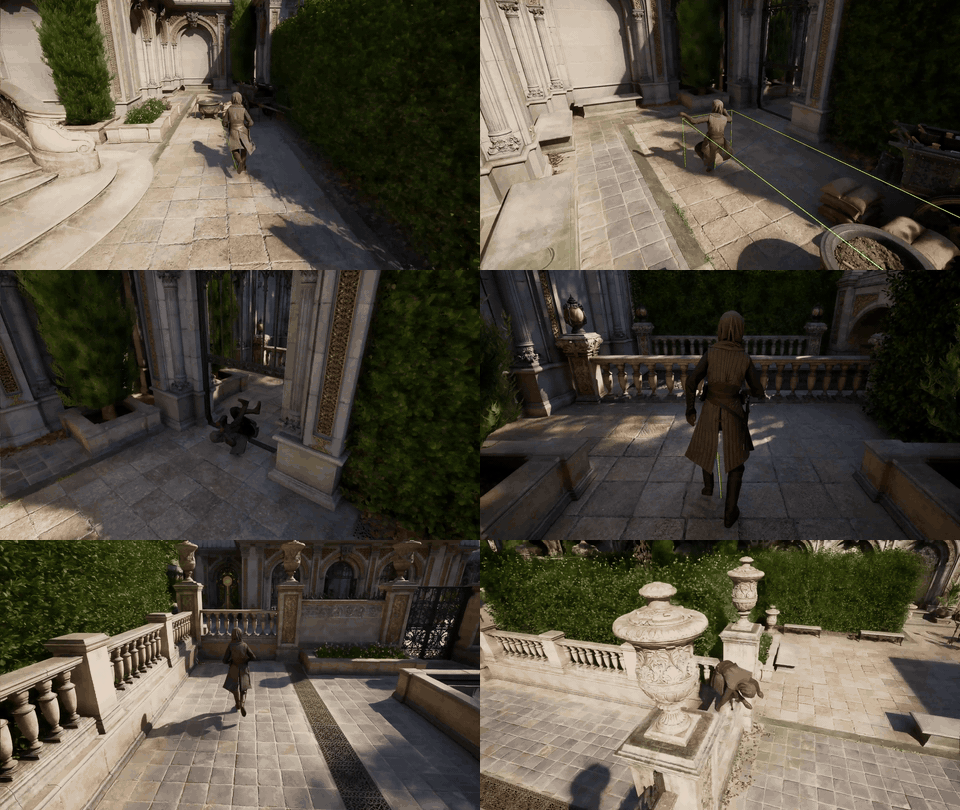
- The official demo material states the runtime needs no foot-locking, no blending, no collision detection, and no hand-authored transitions.
- “First” claims are author self-assessments. The project page frames the UE5-scale demo as, to the authors' knowledge, the first neural model combining that quality, controllability, complexity and completeness. Treat the qualifier as part of the claim.
How the paper and the code relate
The 2026-04-27 public release is a preview: interactive MuJoCo demo, pretrained checkpoints, synthetic training code. The README's roadmap commits the full pipeline — the model embedded in GR00T Whole-Body Control's robotics formulation — roughly one month out from that preview. If a reviewer asks “can I reproduce Table N?”, the honest answer today is the one on the repository's News section, and you should link to it rather than guess.
Want the numbers checked against the hype anyway? The correction post on 350,000 and 15,000 covers the two misreads that circulate most. To run the system behind the paper locally, start with the setup guide and the home page's explainer of what the framework does.