Landscape · GR00T Whole-Body Control
NVIDIA's humanoid motion stack, piece by piece
MotionBricks does not live alone, which is why coverage keeps mangling it. The GR00T Whole-Body Control effort is a set of layers — generation, control, data, retargeting — each with its own repo or page. Here is the map, with every box linked to where NVIDIA itself describes it.
The layers
- MotionBricks — motion generation. The real-time runtime described on the project page; the README calls it, with GEAR-SONIC, one of the two projects that “anchor” the GR00T WBC initiative — the generation layer producing motion frames from commands.
- GEAR-SONIC — whole-body control. The controller layer, documented on its project page and in the same monorepo as MotionBricks (GitHub): it consumes reference motion and executes it on the robot at 50 Hz. Details on the three checkpoints below.
- GR00T N1.5 / N1.6 decoupled WBC. NVIDIA's GR00T N-series model line pairs with decoupled whole-body control work in the same ecosystem; this post only names the placement — see the GR00T-WBC repository for what is currently published there rather than a third-party summary.
- BONES-SEED — the data. The training corpus behind the 350,000-clip claim: bones.studio/datasets as the README points, with the dataset page on Hugging Face. Walkthrough in our download post.
- SOMA Retargeter — the conversion pipe. A Newton-based solver that retargets SOMA capture onto the Unitree G1, producing training data for MotionBricks (GitHub).
- Kimodo — the offline sibling. Per the README's Related Work section, “focused on offline motion generation, complementary to MotionBricks' real-time runtime” (project page, repo).
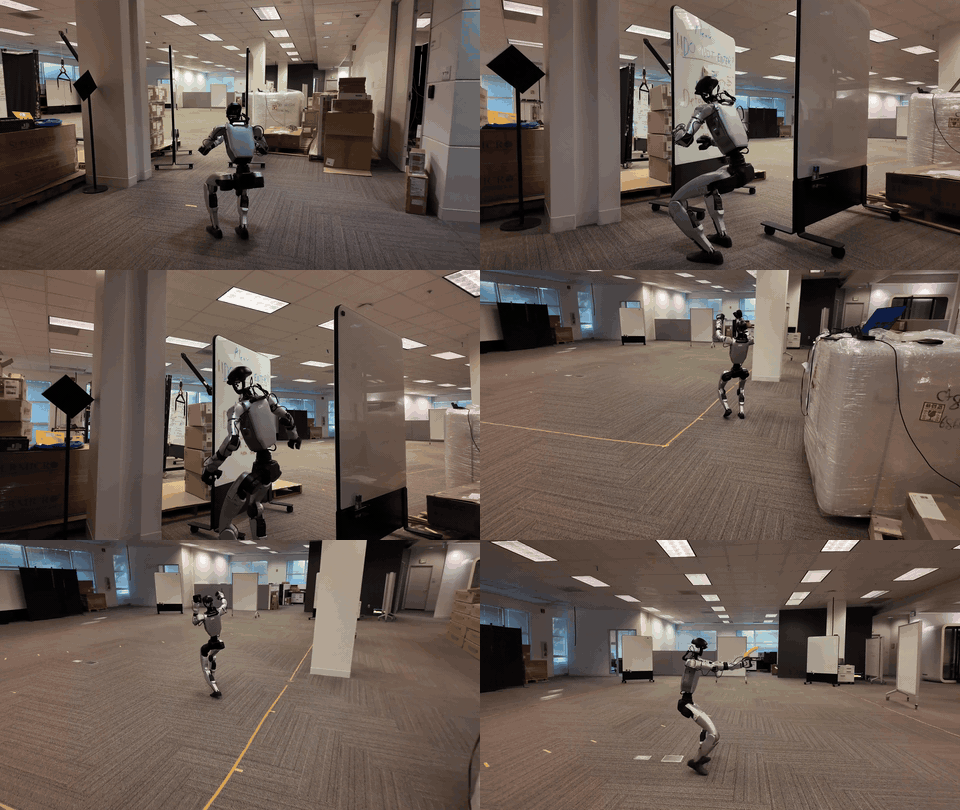
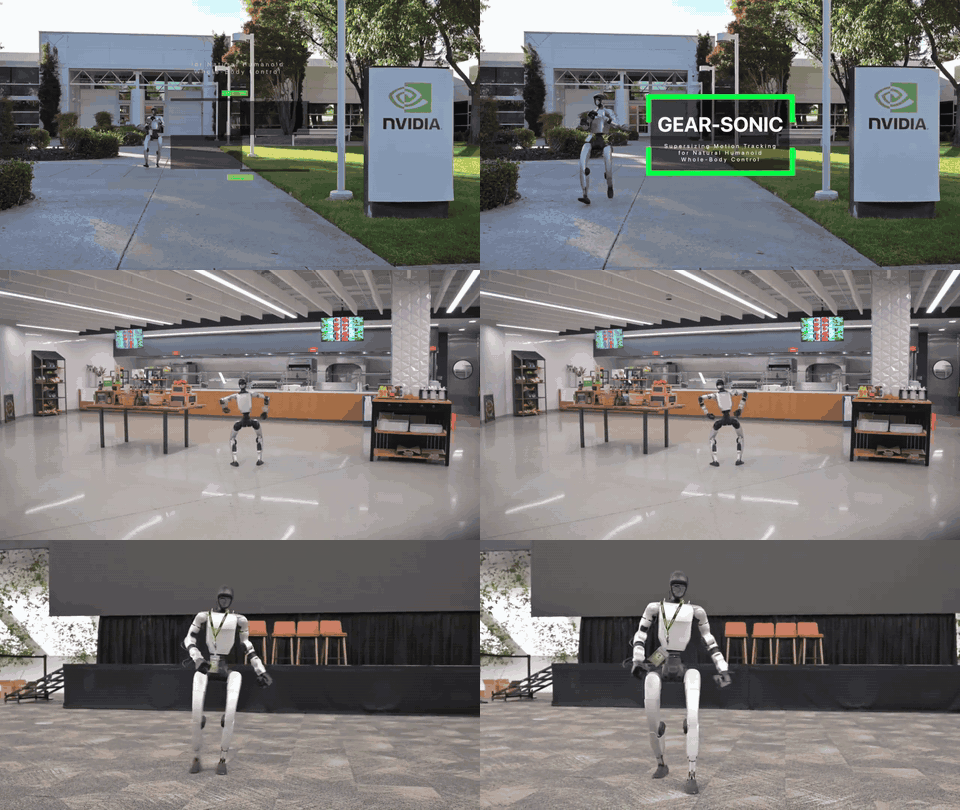
SONIC's three checkpoints, straight from the model card
All three models use the SONIC universal-token controller, produce 64-dimensional latent motion tokens, run the controller at 50 Hz, and support SMPL pose, G1 motion reference, and teleoperation inputs.
| Checkpoint | Reference lookahead | Intended use |
|---|---|---|
| Default SONIC (original release) | 10 future frames at 20 ms spacing, approximately 200 ms of reference lookahead | Default general-purpose SONIC controller for motion tracking, planning, teleoperation, and compatibility with existing deployments. G1 and teleoperation future-reference observations use step5. |
| Low-latency teleoperation · files | 4 future frames at 20 ms spacing, approximately 80 ms of reference lookahead | Intended for more responsive whole-body teleoperation and VLA execution. G1 and teleoperation future-reference observations use step1. Use its encoder, decoder, and observation config together. |
| SONIC v1.1 · files | 10 future frames at 20 ms spacing, approximately 200 ms of reference lookahead | Uses robot-heading-normalized target orientation and was trained with wrist-pose augmentation. Intended for heading-stable whole-body teleoperation and SONIC-backed VLA policies that use this controller. G1 and teleoperation future-reference observations use step5; this is not the low-latency model. |
Release timeline
| Date | What shipped |
|---|---|
| 2026-04-27 | MotionBricks preview release — interactive G1 demo, pretrained checkpoints (VQVAE · pose · root), synthetic training code, motion-representation docs, GIF gallery. |
| 2026-05-07 | GR00T-WBC: end-to-end VLA workflow on G1 (teleop data → Isaac-GR00T N1.7 fine-tune → SONIC deployment). |
| 2026-06-16 | GR00T-WBC: low-latency teleoperation checkpoint (4-frame lookahead) + Isaac Teleop Setup docs. |
| 2026-07-23 | GR00T-WBC: SONIC v1.1 checkpoint (robot-heading-normalized, wrist-pose augmentation). |
Pattern worth noticing: the dates interleave. MotionBricks' preview (2026-04-27) came first in this window; the WBC repo answered with the VLA workflow, the low-latency checkpoint, and v1.1. The stack moves as a stack — which is precisely why the generation layer alone will not drive your robot. For the runtime piece in isolation, see the installation guide, and keep up with the guides indexed here as layers change.